St. Charles homes built before 1980 often run on 100-amp panels that cannot support a 240-volt Level 2 charger without an upgrade. Adding a dedicated 40- or 60-amp circuit requires pulling permits through the City of St. Charles and coordinating with ComEd for any service changes. Outdoor units must be rated for Illinois winters where temperatures regularly drop below zero and wind-driven snow packs around wall-mounted enclosures.
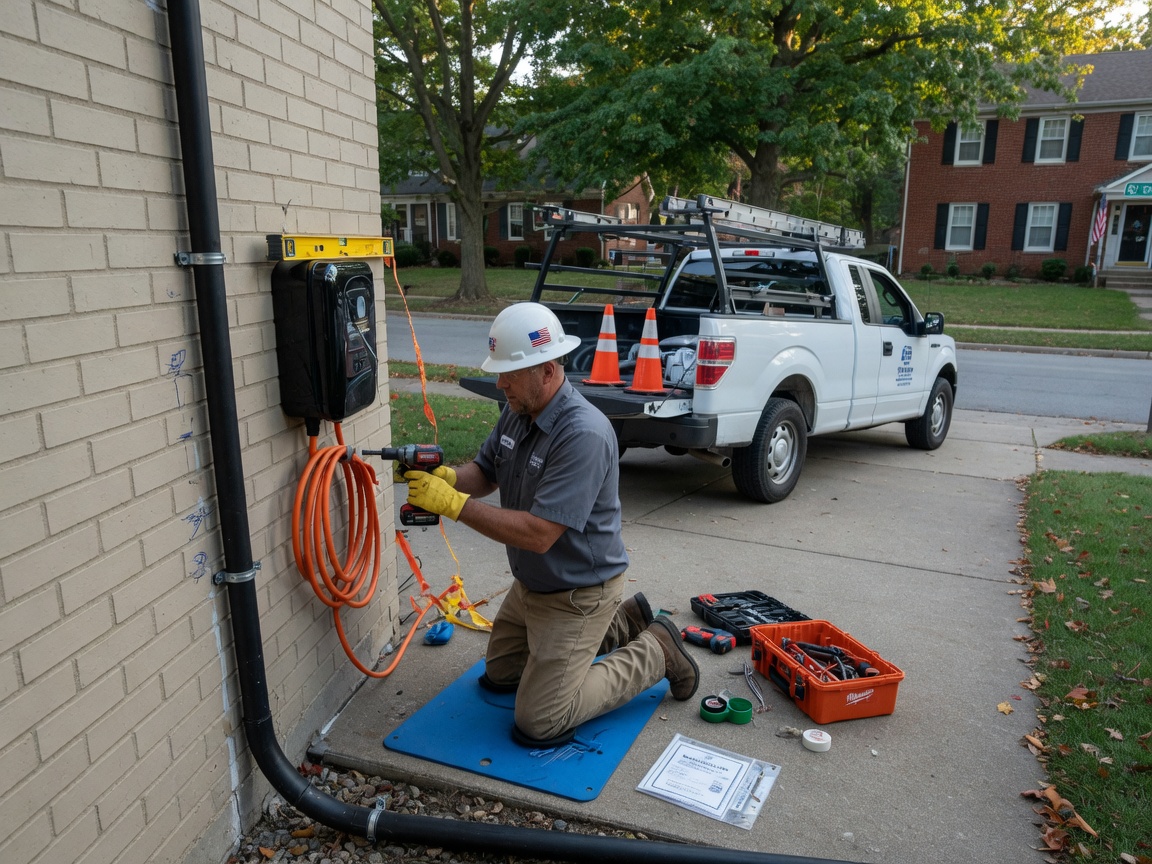
We mount chargers on finished basements or garage walls using heavy-duty backplates and seal all penetrations with exterior-grade caulk to prevent moisture from reaching wiring. In neighborhoods like the historic district or near Pottawatomie Park, narrow driveways and mature landscaping can limit conduit routes, so we sometimes run surface-mounted Wiremold to keep trenches out of established yards. Load calculations always account for existing central air, electric dryers, and well pumps common on larger lots west of Randall Road.
Edge cases include aluminum service entrance cables that require anti-oxidant compound and torque verification, plus GFCI protection mandated by the 2023 NEC adoption in Kane County. We verify the final installation with a megger test and leave the homeowner a one-line diagram showing the new breaker position and wire gauge for future reference.
Technician insight
In St. Charles the thing that catches most people out with EV Charger Installation is the number of 1960s and 1970s split-level homes still running 100-amp panels with aluminum branch wiring. Once winter temperatures drop, any undersized or corroded connections heat up faster under continuous EV charging loads, so we always check torque and upgrade the feeder before the charger goes in.
Historic District Garage Install
Homeowner in the St. Charles historic district wanted a 48-amp charger but had a 100-amp fuse panel. We identified aluminum service cable and limited wall space. A 200-amp panel was installed in the basement with a new conduit run along the foundation to the garage. The charger now operates without tripping breakers even during peak summer air-conditioning use.
EV Charger Installation Services We Offer
✓Level 2 Charger Installation
Hardwired 240-volt charger mounting with dedicated circuit sized for 30- to 60-amp loads in St. Charles garages.
✓Electrical Panel Upgrade for EV
Replacement of 100-amp panels with 200-amp service to accommodate EV charging plus existing home loads.
✓Outdoor EV Charger Mounting
Weatherproof installation on exterior walls with conduit rated for freeze-thaw cycles along the Fox River corridor.
✓EV Charger Circuit Addition
New 6- or 4-gauge wiring run from panel to charger location without disturbing finished surfaces where possible.
✓Permit and Inspection Coordination
City of St. Charles electrical permit filing and scheduling of final inspection for code compliance.
EV Charger Installation Cost in St. Charles, IL
| Service | Typical Range | What Affects It |
|---|---|---|
| Level 2 Charger Circuit Only | $850–$1,600 | Varies with distance from panel and wall type |
| 200-Amp Panel Upgrade Plus Charger Circuit | $2,800–$4,200 | Includes service entrance cable if needed |
| Outdoor Rated Charger Mounting | $350–$650 | Adds conduit and weatherproof enclosure |
| Permit And Inspection Fee Handling | $150–$275 | City of St. Charles fees plus coordination time |
Ranges are typical for St. Charles, IL and confirmed with an exact written quote before any work starts.
How it works
- 1
Site Assessment
We inspect the existing panel, service entrance, and proposed charger location in your St. Charles home to identify any capacity or routing constraints.
- 2
Load Calculation
Detailed calculation of current and future loads determines the correct breaker size and whether a panel upgrade is required.
- 3
Permit Submission
We prepare and submit the electrical permit to the City of St. Charles and schedule the work once approved.
- 4
Installation And Testing
Dedicated circuit is installed, charger mounted, connections torqued, and the system is tested before final inspection.
Pricing
Cost depends on panel capacity, charger amperage, and whether conduit must be run through finished spaces or exterior walls.